Dr. Bal Chander
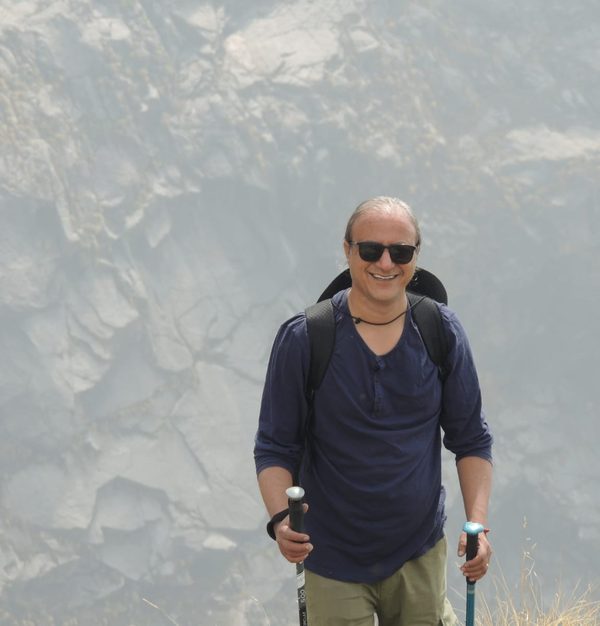
AIIMS alumnus. Professor of Pathology at Dr. Rajendra Prasad Government Medical College, Himachal Pradesh. Sole inventor and patent owner of Hemocorr. Nineteen years in academic medicine. Occasional solo trekker.
This page is a more complete account of who I am, how I got here, and what I have been doing with my time. It is meant to be read as a conversation rather than a curriculum vitae.
The formal part
Publications worth mentioning
Most of what follows falls under the heading of functional autopsy — a term I use for the practice of asking not just what an organ looks like, but what it was actually doing. Several of these papers represent firsts: either the first demonstration of a specific finding, or the first attempt at an explanation nobody had tried before. I am listing only the ones I think are genuinely worth the reader's time.
What AIIMS did — and did not — teach me
I arrived at AIIMS as a first-year undergraduate expecting to meet people who were as curious about what they were teaching as they were proficient at it. There were excellent clinicians there — that is not in question. But the process of discovery, the history of how medical knowledge accumulated, the honest acknowledgement of what remained unknown — these were mostly absent. One teacher from my school years at Sainik School, Mr SSD, had approached his subject very differently. At AIIMS, that kind of intellectual engagement was rare.
There is something particular to medicine that makes this worse than it might be in other fields. Doctors are expected to know. A patient sitting across from you needs confidence, not uncertainty, and so the professional culture trains you — gently but firmly — to project knowledge even when you don't have it. The comparatively honest doctor says "it isn't known" or "nobody knows." Almost nobody says "I don't know, but let me find out." That pretension propagates from teacher to student until it hardens into something close to the truth — and once it does, honest self-appraisal becomes genuinely difficult, and sincere innovation becomes almost impossible. You cannot identify a gap you have trained yourself not to see.
The undergraduate years were largely spent reading outside medicine — mathematics, physics, general science, anything that seemed interesting. I passed the examinations with the minimum necessary effort. I am not recommending this as a strategy. But the reading that went alongside it — across subjects with no obvious connection to medicine — turned out to be exactly what Hemocorr eventually required.
I chose pathology for the specialisation because it sits at the centre of everything. To do it properly you need enough vocabulary to talk to the surgeon, the molecular biologist, the clinician, the geneticist. That part worked as expected. The research culture was a harder adjustment — the dominant pattern was replication rather than origination, and I spent a good part of my time at AIIMS forming views about what I would not do with whatever intellectual energy I had. That is probably not an unusual experience for a certain kind of mind in a large institution. I eventually stopped expecting otherwise and got on with my own work.
A brief and instructive failure — and what came after
After AIIMS I ran my own diagnostic laboratory for a period. The commercial practice of medicine in India — the commissions, the incentive structures, the competition for referrals — was not something I managed to adapt to. When the laboratory closed it had taken my savings with it. I returned to medical college teaching, which is where I have remained since. In 2011 I joined my current post at Dr. Rajendra Prasad Government Medical College in Himachal Pradesh, which I have now held for fourteen years.
I am not sure the failure was entirely avoidable. It removed one possible path and left the others somewhat clearer, which in retrospect was probably the more useful outcome.
When I began teaching pathology I made a deliberate decision to teach not just what we know but how we came to know it — the history of discovery, the reasoning behind the conclusions, the honest acknowledgement of what the textbook cannot tell you. I try to communicate the limits of existing knowledge alongside its content, and I encourage students to think critically about what I am telling them, including the parts I may not fully understand myself.
I cannot claim great success at this. The pressure to memorise and replicate is strong, and most students are focused on passing examinations, which is entirely reasonable. But teaching this way has served a different purpose for me: it functions as a kind of continuous audit. Standing in front of a class and attempting to explain the deeper logic of pathology reveals, repeatedly, how much of the subject I do not understand. Nineteen years of that has been valuable. Mostly as a lesson in humility.
Trekking and research — a closer parallel than it appears
I trek alone, preferably in poor weather, on routes that are not well used. It is not something I would recommend to everyone. But for me it has been essential — not as recreation but as conditioning.
The parallel to research is not metaphorical; it is operational. Both are solitary, with imperfect maps and incomplete information. Both require decisions whose consequences you live with alone. Both involve long stretches of nothing followed by brief moments of clarity. In trekking, success is mostly private and failure tends to be public and loud. Research is similar: you arrive somewhere having worked very hard, feel satisfied about it for a short time, and then turn around and start the next problem.
Working in the hills of Himachal Pradesh, in conditions that were often less than ideal, conditioned me well for conducting research with the facilities I had rather than the ones I might have liked.
Hemocorr was largely conceived and developed during the kind of solitary thinking that trekking creates space for. I do not think it is a coincidence.
Brothers and wife
The biographical convention is to thank people briefly at the end. I want to resist that, because it does not come close to the reality.
I have two brothers, both doctors, both broadly self-educated in areas well outside their formal training. The intellectual culture that made Hemocorr possible was formed as much in conversations with them as in anything I read. The disposition that led to it was shaped by growing up in the same environment and continuing to think alongside each other over many years.
My wife has sustained the practical reality of a household in which the main occupant spent years appearing to do nothing commercially useful, while being entirely convinced that what he was doing mattered. Beyond that, she has been instrumental in pushing me forward when I — a chronic procrastinator — drag my feet. Her faith in my pursuits cancels out my generally pessimistic outlook, and her equipoise in the face of apparent setbacks acts as a shock absorber. She is, in the most literal sense, the vital support system.
Have I done anything substantial? Not really. I am as ignorant as I ever was, and whatever I have managed is largely common sense — common sense I could not have arrived at without them. It is a humbling thing to acknowledge, and I acknowledge it without embarrassment.
Get in touch
If anything on this site resonates — whether you are a clinician, an engineer, an investor, or simply someone who found their way here — I am glad to hear from you.