A concept and design for a revolutionary medical device aimed at critically ill patients
Hemocorr — a technical brief
A patented concept and design for an extracorporeal closed-loop platform that would couple multi-analyte real-time sensing with targeted, drug-free molecular correction — built from validated component technologies that have never been integrated on a single platform.
A high-dimensional, non-linear, non-stationary dynamical system — currently observed by snapshots
A critically ill patient's physiology is, in systems-engineering terms, a high-dimensional non-linear dynamical system — and it is operating far from equilibrium. State variables are the concentrations of hundreds of circulating molecules and ions, none of them independent: every organ reads and writes to the same shared chemical bus.
Relationships between any two analytes show saturable kinetics, feedback inhibition, threshold effects, and time delays — standard signatures of non-linear control systems, requiring coupled non-linear differential equations to describe.
A critically ill patient is a weather system in an unstable state — numerous non-linearly coupled variables that can transition between attractors, recovery and irreversible failure, on timescales of minutes.
Fitting a predictive model demands continuous, high-frequency, multi-variable measurement. Medicine provides the opposite — sparse, single-variable snapshots. That's a measurement-technology deficiency, not a clinical one.
Hemocorr is designed to provide what the measurement technology currently cannot, and to correct the system state without introducing additional uncharacterised perturbations — a non-perturbative observer with a targeted, selective actuator.
The constraints are architectural, not incremental
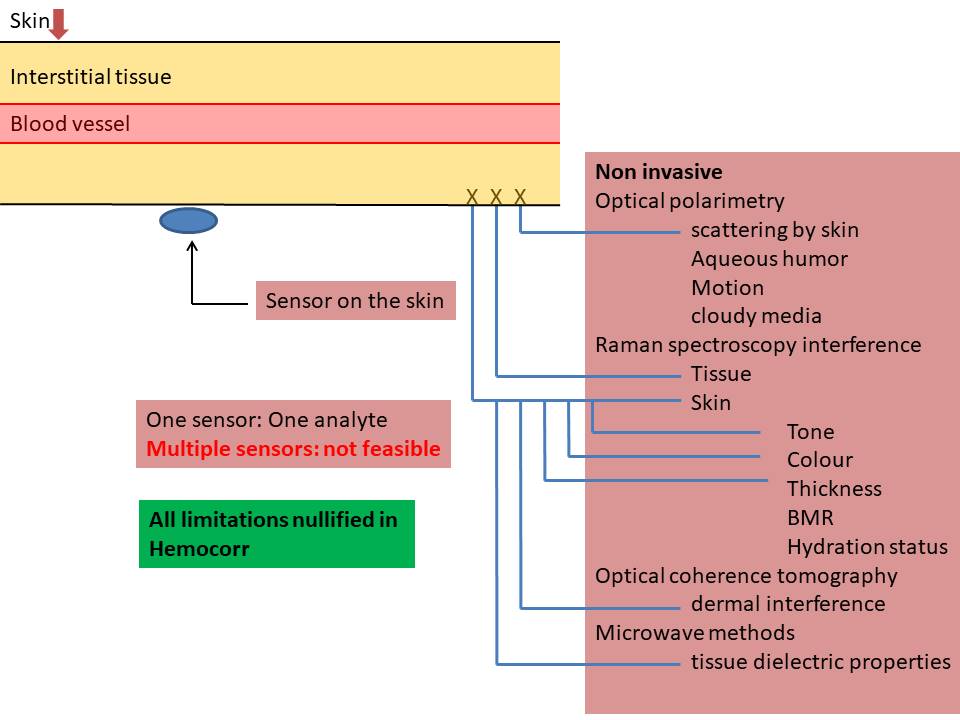
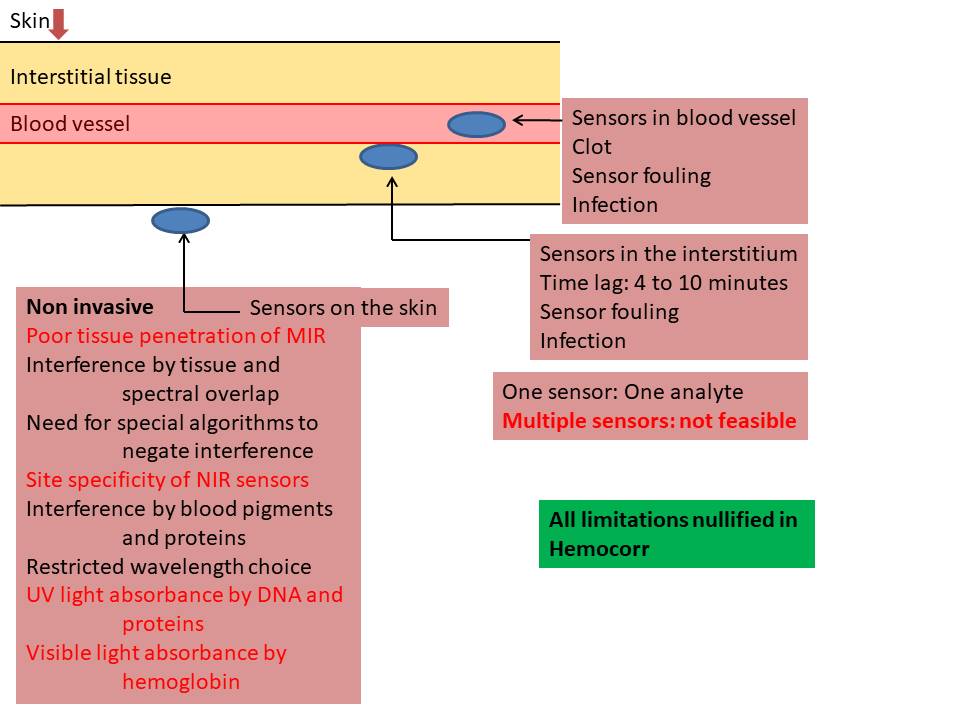
Transcutaneous optical sensors (NIR, Raman, MIR)
NIR penetrates tissue reasonably but gives weak, interference-prone signals; MIR has clearer spectral features but shallow penetration. Both are limited by scattering, spectral overlap, and signal variation with perfusion, hydration, melanin, and temperature.
Each additional sensor adds its own interference terms — accuracy doesn't scale with sensor count, it deteriorates.
Subcutaneous electrochemical sensors
A 4–15 minute diffusion lag, widening unpredictably during rapid transitions — exactly when accuracy matters most. Biofouling degrades performance over time; antifouling coatings reduce but don't eliminate it.
Intravascular sensors
Chronic implantation brings biofouling and immune encapsulation; intravascular placement triggers platelet activation and coagulation at the sensor surface — particularly for electrochemical sensors needing direct plasma contact.
These limitations multiply. A single compromised in-vivo sensor monitoring one analyte is marginal; deploying dozens on or in a patient for continuous, days-long, multi-analyte monitoring is neither practical nor clinically acceptable.
The engineering conclusion: the constraints on in-vivo and transcutaneous sensing are architectural. The measurement matrix is fundamentally ill-conditioned in the in-vivo setting. The path forward does not run through iterative improvement of in-vivo sensor designs — it runs through removing the measurement from the body entirely. Hemocorr is designed to circumvent all these limitations.
Eight steps — extracorporeal, non-perturbative, closed-loop
Relocate measurement and correction to an external circuit, where in-vivo sensing constraints disappear and analytical chemistry can be deployed without biocompatibility limits. Monitoring must not alter what it measures; correction must target only the specified analyte.
Modular by design. Analyte count is a configuration parameter, not an architectural constraint. Steps 1–4 alone — fractionation, sensing, verification, return — form a complete, independently valid monitoring product. Correction is separable: each analyte's capture step can be added individually, so the platform scales without redesign.
Externalise the measurement problem — peristaltic pump, controlled flow rate
Rationale
Tissue is eliminated as an interference medium, opening the sensor design space from clinically implantable to simply analytically capable.
Mechanism
Blood is drawn continuously via peristaltic pump at a flow rate set by safe haematological limits and the system's fastest time constants.
Centrifugal separation — cellular fraction returned, acellular plasma continues
Rationale
Erythrocytes dominate whole blood's optical cross-section, making sensing at physiological concentrations effectively impossible in whole blood; platelet removal eliminates coagulation-cascade initiation at electrochemical sensors.
Mechanism
Continuous centrifugation separates cells from plasma; cells return directly to the patient. Plasma's dominant absorbers — broadband proteins — are separable from small molecules' sharp spectral features.
From separation to sensing — combined view
Multi-analyte sensor array — optical and electrochemical, in parallel
Rationale
Sensor count scales freely once measurement is externalised; uniform channel material removes inter-patient calibration variance. The limit is cost-benefit, not physics.
Mechanism
With cell-free plasma in a uniform-material channel, optical sensors (NIR, Raman, MIR, fluorescence) sit in transmission/ATR geometry; electrochemical sensors embed in the wall without biofouling risk.
Plasma fractionation — molecular-weight filtration to reduce spectral complexity
Rationale
Physical-domain signal pre-processing that enriches the target relative to interferents, reducing the measurement matrix's condition number.
Mechanism
Semipermeable membranes with defined molecular-weight cut-offs fractionate the plasma. Unlike dialysis, the permeate side is ultrapure water — a pure molecular-weight filter.
Chemical capture — target-specific, magnetised, non-systemic actuator
Rationale
Satisfies the non-perturbative constraint: nothing is removed except the specified target, and multiple targets can be corrected in parallel.
Mechanism
Capturing molecules — a high-affinity binding domain, a magnetic label, and physical size large enough that systemic entry is effectively zero — enter the plasma stream when a target exceeds range; a magnetic field sweeps out the complexes.
Capture and verification — combined view
Post-correction verification — second sensor pass, feedback loop
Rationale
Standard closed-loop control — measure, actuate, measure again — implemented in the physical process itself, not just software.
Mechanism
Plasma passes the sensor array again; anything still out of range routes back to Step 5 for a further correction cycle.
Plasma reinfusion — zero net blood loss, continuous operation constraint
Rationale
Zero blood loss is an explicit design constraint, given continuous operation over days or weeks.
Mechanism
Corrected plasma, combined with Step 2's returned cells, reconstitutes the patient's blood with zero net loss.
Continuous cycling until system stability — full blood volume coverage
Rationale
A single pass cannot cover the whole blood volume; the objective is maintaining target concentrations across the entire circulating pool, not just one pass.
Mechanism
The loop runs continuously at physiologically appropriate flow rates, processing the full blood volume multiple times per hour, until the clinical team confirms stable equilibrium.
Every limitation, resolved
Continuous multi-analyte data would enable something medicine currently cannot do — ideal data to train AI
The continuous, synchronised, multi-analyte trajectories produced would be the input to a coupled non-linear ODE/PDE model of the patient's state — useful precisely where outcomes are expected but the underlying mechanism can't be directly intuited.
For the first time this would let clinicians fit high-dimensional non-linear models to individual patients, estimate coupling constants between analyte pairs, and simulate trajectories under different interventions.
The practical implication: a fitted model could generate forward trajectories — probability distributions over future states, including transition probabilities to irreversible failure. That's quantitative prognosis: an estimated, continuously updated probability of where the system is heading, not just "this patient is deteriorating."
The Hemocorr data stream would also be the foundational training dataset for AI-based prognostic models in critical care. The AI-driven ICU decision support market reached $2.33 billion in 2025 and is forecast to exceed $16 billion by 2034 at a CAGR of 24.1%. The data that these systems need and currently lack is exactly the data Hemocorr would generate.
No continuously sampled, multi-analyte blood chemistry time series from a critically ill patient spanning hours or days at sub-minute resolution currently exists anywhere in medicine. Hemocorr would produce it.
What exists and what is needed
Component technologies are already validated in clinical or laboratory use. An international patent was filed in 2019; following EPO examination:
- 41/44 claims assessed as novel — not anticipated in any prior art reviewed
- 41/44 claims assessed as inventive — not hinted at, not obvious
- 44/44 claims assessed as industrially applicable
- EPO finding: "does not appear to be disclosed nor hinted at in the prior art"
US Patent 12,350,039 B2 (granted July 8, 2025)
Indian Patent 567865 · PCT/IN2020/050415
The engineering challenge is integration — combining validated components on one closed-loop platform with flow control, sensor-to-actuator communication, real-time feedback, and ICU-grade reliability.
A substantial project, but a clear-scope one with a component inventory that already exists — no new science required. IP is granted, owned by a single inventor with no co-owners or licensees.
The inventor is seeking engineering partners, researchers, and investors to translate the patent into a working prototype, and responds personally to every enquiry.
From the inventor
I am a pathologist who found a gap in critical care and worked out an engineering solution — I am not an engineer. The architecture is complete and, to my knowledge, novel. I cannot build it myself.
If you work in multi-modal sensing, extracorporeal fluidics, molecular capture chemistry, or non-linear dynamical modelling, and the case here is convincing — I'd welcome your engagement at any level.
Every component already exists. What's needed is the expertise and resource to put them together for the first time.
Dr. Bal Chander · AIIMS alumnus · Professor, Dept. of Pathology · Dr. RPG Medical College, H.P., India · WIPO: PCT/IN2020/050415