Hemocorr, in plain words
A concept and design for a revolutionary medical device aimed at critically ill patients
Hemocorr is a patented concept and design — grants in hand for the US and India — for a device that would watch dozens of things in a patient's blood at once, continuously, and gently correct the ones that are wrong, without giving any new drug to do it.
Start here
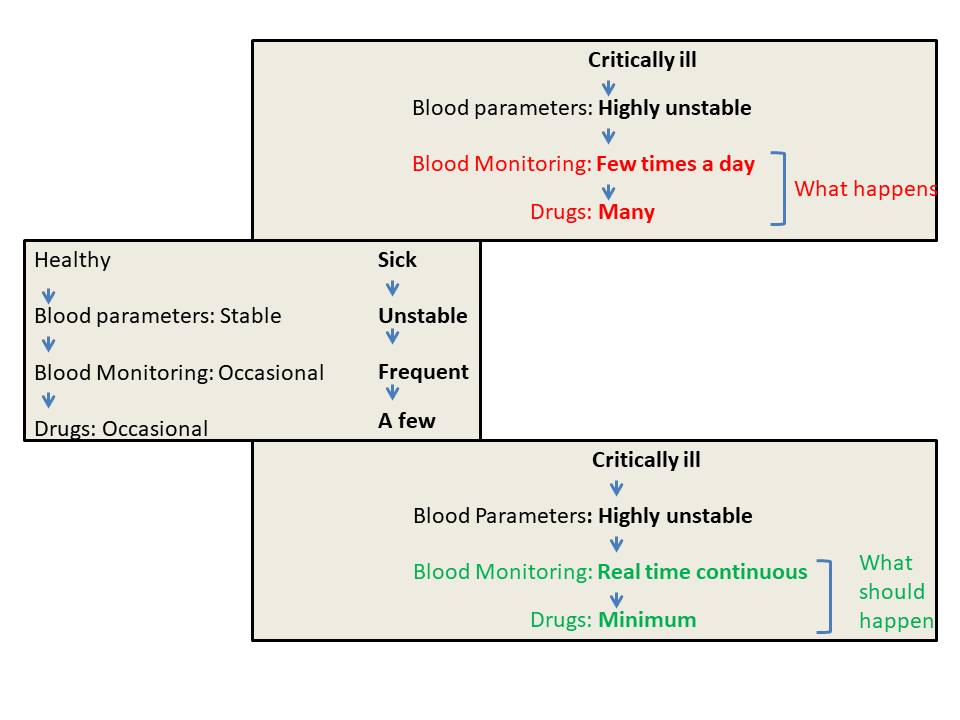
Someone you know is in an intensive care unit. Nurses check vitals every hour; a monitor traces the heartbeat continuously. But blood test results arrive hours after being drawn. The 25 or more drugs being given are dosed by experience rather than real-time knowledge of what the body needs right now.
This is a gap in medical technology, not a failure of care — between what would be useful to know and what current equipment can tell us.
Hemocorr is a patented design for a device that would close it. It doesn't exist as a working machine yet, but the patents are granted and every component it needs already exists in other medical devices.
In short: Hemocorr is not science fiction and not a finished product. It is a detailed, patented plan for something that is genuinely buildable — waiting for the right partners to build it.
ECG, BP & O2 : 24 Hrs
Blood samples: 3-4 times/24 Hrs
Reports: Lag Period (1/2 to 2 hrs)
What the ICU monitors — and what it does not
Every intensive care unit runs three monitors that never switch off — ECG, blood pressure, pulse oximeter — because a change in the heart or breathing can mean the difference between life and death within seconds.
But blood — the medium every organ uses to signal every other organ — is checked only a few times a day, with results hours later. Over 5 million patients enter US ICUs yearly; mortality runs 8–19% despite best care, and some of that is changes not caught in time.
Blood is the body's internal messaging system
Blood isn't just a carrier of oxygen — it's the body's communications network. Every organ constantly sends and receives chemical messages through it. In serious illness, these levels rise and fall within minutes.
Current testing is like following a film from a handful of still photographs, hours apart — missing most of what happened in between, including the moments that mattered most. Hemocorr is designed to turn those photographs into continuous video.
More complicated than it looks
When blood chemistry goes wrong in an ICU patient, the main tool is drugs. Critically ill patients receive 25–35 medications on average per stay — twice ordinary-ward patients.
Managing that many drugs at once — avoiding interactions, dosing correctly as chemistry shifts hour by hour — is genuinely difficult. Over 10% of preventable ICU adverse events trace to drug interactions alone.
The paradox: the sicker the patient, the more drugs they need, and the more vulnerable they are to those drugs' effects.
Hemocorr would correct abnormal levels without adding any drug. Capturing particles in an external circuit bind to one specific target and are pulled out by a magnet, leaving everything else untouched.
Eight steps, repeating continuously
Each step has a clear reason. Every step uses technology that already exists in other medical devices.
Blood drawn to bedside device
A pump draws a thin, continuous stream from the patient — the same method used in dialysis for decades.
Cells separated — returned immediately
The cellular components are spun off and sent straight back to the patient. Nothing is lost. Plasma continues through the device.
Dozens of sensors read simultaneously
Each sensor targets one substance. All read at once, in real time, with no tissue interference and no practical limit on how many can be used.
Plasma simplified where needed
Filtering membranes reduce background complexity, giving each sensor a cleaner reading — similar to how dialysis uses membranes, but for accuracy rather than waste removal.
Chemical capture — no drug required
Purpose-built molecules latch onto exactly one specific target, like a key fitting one lock. A magnetic field then pulls the complex out — without touching anything else.
The correction is verified
The plasma passes through the sensors a second time. If levels are still off, the correction repeats. Nothing returns to the patient until the check is passed.
Corrected blood returned — zero loss
The corrected plasma rejoins the blood cells already returned in Step 2 and flows back to the patient. What left the body comes back, improved.
Cycle repeats until the patient is stable
The loop runs continuously — hours or days — monitoring and correcting the full blood volume until the clinical team decides it can stop.
Benefits Hemocorr brings to patients
Are you a clinician? If any of this resonates with what you see in practice — we would like to hear from you.
Add your voice →Not science fiction — and not a distant dream
Every individual component Hemocorr would use already exists in validated clinical or laboratory use. Not one of them needs to be invented from scratch.
- Taking blood out and returning it through a tube: dialysis machines have done this for decades. Millions of people are alive because of this technology.
- Separating blood cells from plasma by spinning: standard procedure in blood banks worldwide.
- Sensors for measuring substances in blood: already exists and are being used.
- Magnetic nanoparticle capture in an extracorporeal circuit: validated in published scientific literature for removing specific cells and molecules from blood outside the body.
- What has not been done before: integrating all of these on one closed-loop platform — sensing, correcting, verifying, returning, continuously. That is where the novelty lies, and what the patents protect.
Reasonable expectations — no promises of miracles
What can reasonably be said, without promising outcomes for an unbuilt device: a working Hemocorr would give doctors a continuous, real-time picture of blood chemistry — changing decisions the way continuous cardiac monitoring changed care over hourly pulse checks.
It would correct abnormal chemistry without drugs, easing the polypharmacy burden, and its continuous data would help build better prognostic models over time.
None of this is guaranteed — the device still needs engineering, testing, and regulatory approval. A long road, but a reasonable goal.
A direct appeal
I am a doctor, not an engineer — a professor of pathology in northern India, an AIIMS New Delhi alumnus, examining tissue and studying critical illness after it has run its course.
Hemocorr began with two deaths I couldn't fully explain. I could name the cause; I couldn't explain the molecular chain that led to it, because that data didn't exist. I became convinced a device to collect it was both possible and necessary.
I've spent years on the design, filed and had the patents granted — alone, with no funding. I cannot build it alone.
If the concept makes sense to you, please tell someone — a doctor, an engineer, an investor, anyone who might recognise the problem and help solve it.
Dr. Bal Chander · Professor, Dept. of Pathology · Dr. RPG Medical College, H.P., India